![]() |
paceval. 4.26
Documentation of the paceval. source-code, Copyright ©1994-2024. Version 1.x, 2.x, 3.x, 4.x ©1994-2025 Joerg Koenning & paceval UG [Registered Trade Mark] All rights reserved., Author(s) : Joerg Koenning
|
specification of the main interface of paceval's API and the main class paceval_cComputation More...
#include "../../source_public/inc/paceval_main.h"#include "paceval_dVersion.h"#include "paceval_cCleanupHandler.h"#include "paceval_cSyntacticAnalysis.h"#include "paceval_cGraph.h"#include "paceval_cListOfVariables.h"

Classes | |
| class | paceval_cComputation |
| The main class paceval_cComputation encapsulates all the work steps that a user's passed function is analyzed and transferred into the linked list of atomic mathematical operations and stored in memory. More... | |
Functions | |
| unsigned long | paceval_getCurrentTime () |
| bool | paceval_identifyConstantFromString (const char *valueOperator_in, bool *constantValueIsTrusted_out, long double *constantValueAsLongDouble_out, double *constantValueAsDouble_out, float *constantValueAsFloat_out) |
| bool | paceval_precheckMultipleComputations (PACEVAL_HANDLE handle_pacevalComputations_in[], unsigned long numberOfpacevalComputations_in) |
| bool | pacevalLibrary_InternalGetComputationResult (PACEVAL_HANDLE handle_pacevalComputation_in, unsigned long numberOfThreadsToUse_in, paceval_eCalculationPrecisionTypes useCalculationPrecision_in, void *values_in, void *result_out, unsigned int sizeOfLongDouble_in, long double *trustedMinResult_out, long double *trustedMaxResult_out) |
| bool | paceval_cComputation_doComputation (PACEVAL_HANDLE handle_pacevalComputation_in, const bool singleCalculation_in, const unsigned long startSpecificAtNode_in, const unsigned long endSpecificAtNode_in, const unsigned int sizeOfLongDouble_in, const paceval_eCalculationPrecisionTypes useCalculationPrecision_in, void *result_out, const unsigned long stackNumber, bool *error_out, void *errorInformation_out, void *trustedMinResult_out, void *trustedMaxResult_out) |
| bool | pacevalLibrary_Initialize (const char *initString_in) |
| bool | pacevalLibrary_Free () |
| PACEVAL_HANDLE | pacevalLibrary_CreateComputation (const char *functionString_in, unsigned long numberOfVariables_in, const char *variables_in, bool useInterval_in, paceval_callbackStatusType *paceval_callbackStatus_in) |
| bool | pacevalLibrary_CreateMultipleComputations (PACEVAL_HANDLE handle_pacevalComputations_out[], const char *functionStrings_in[], unsigned long numberOfpacevalComputations_in, unsigned long numberOfVariables_in, const char *variables_in, bool useInterval_in, paceval_callbackStatusType *paceval_callbackStatus_in) |
| bool | pacevalLibrary_ExistComputation (PACEVAL_HANDLE handle_pacevalComputation_in) |
| bool | pacevalLibrary_DeleteComputation (PACEVAL_HANDLE handle_pacevalComputation_in) |
| int | pacevalLibrary_ldConvertFloatToString (char *destinationString_in, long double float_in) |
| int | pacevalLibrary_dConvertFloatToString (char *destinationString_in, double float_in) |
| int | pacevalLibrary_fConvertFloatToString (char *destinationString_in, float float_in) |
| long double | pacevalLibrary_ldConvertStringToFloat (const char *sourceString_in, int *errorType_out, long *errPosition_out, bool useInterval_in, long double *trustedMinResult_out, long double *trustedMaxResult_out) |
| double | pacevalLibrary_dConvertStringToFloat (const char *sourceString_in, int *errorType_out, long *errPosition_out, bool useInterval_in, double *trustedMinResult_out, double *trustedMaxResult_out) |
| float | pacevalLibrary_fConvertStringToFloat (const char *sourceString_in, int *errorType_out, long *errPosition_out, bool useInterval_in, float *trustedMinResult_out, float *trustedMaxResult_out) |
| long double | pacevalLibrary_ldmathv (PACEVAL_HANDLE *handle_pacevalComputation_out_in, int *errorType_out, const char *functionString_in, unsigned long numberOfVariables_in, const char *variables_in, long double values_in[]) |
| double | pacevalLibrary_dmathv (PACEVAL_HANDLE *handle_pacevalComputation_out_in, int *errorType_out, const char *functionString_in, unsigned long numberOfVariables_in, const char *variables_in, double values_in[]) |
| float | pacevalLibrary_fmathv (PACEVAL_HANDLE *handle_pacevalComputation_out_in, int *errorType_out, const char *functionString_in, unsigned long numberOfVariables_in, const char *variables_in, float values_in[]) |
| long double | pacevalLibrary_ldmathvi (PACEVAL_HANDLE *handle_pacevalComputation_out_in, int *errorType_out, long double *trustedMinResult_out, long double *trustedMaxResult_out, const char *functionString_in, unsigned long numberOfVariables_in, const char *variables_in, long double values_in[]) |
| double | pacevalLibrary_dmathvi (PACEVAL_HANDLE *handle_pacevalComputation_out_in, int *errorType_out, double *trustedMinResult_out, double *trustedMaxResult_out, const char *functionString_in, unsigned long numberOfVariables_in, const char *variables_in, double values_in[]) |
| float | pacevalLibrary_fmathvi (PACEVAL_HANDLE *handle_pacevalComputation_out_in, int *errorType_out, float *trustedMinResult_out, float *trustedMaxResult_out, const char *functionString_in, unsigned long numberOfVariables_in, const char *variables_in, float values_in[]) |
| long double | pacevalLibrary_ldGetComputationResult (PACEVAL_HANDLE handle_pacevalComputation_in, long double values_in[], long double *trustedMinResult_out, long double *trustedMaxResult_out) |
| double | pacevalLibrary_dGetComputationResult (PACEVAL_HANDLE handle_pacevalComputation_in, double values_in[], double *trustedMinResult_out, double *trustedMaxResult_out) |
| float | pacevalLibrary_fGetComputationResult (PACEVAL_HANDLE handle_pacevalComputation_in, float values_in[], float *trustedMinResult_out, float *trustedMaxResult_out) |
| bool | pacevalLibrary_ldGetComputationResultExt (PACEVAL_HANDLE handle_pacevalComputation_in, long double values_in[], unsigned long numberOfCalculations_in, long double *results_out, long double *trustedMinResults_out, long double *trustedMaxResults_out, int *errorTypes_out) |
| bool | pacevalLibrary_dGetComputationResultExt (PACEVAL_HANDLE handle_pacevalComputation_in, double values_in[], unsigned long numberOfCalculations_in, double *results_out, double *trustedMinResults_out, double *trustedMaxResults_out, int *errorTypes_out) |
| bool | pacevalLibrary_fGetComputationResultExt (PACEVAL_HANDLE handle_pacevalComputation_in, float values_in[], unsigned long numberOfCalculations_in, float *results_out, float *trustedMinResults_out, float *trustedMaxResults_out, int *errorTypes_out) |
| bool | pacevalLibrary_ldGetMultipleComputationsResults (PACEVAL_HANDLE handle_pacevalComputations_in[], unsigned long numberOfpacevalComputations_in, long double values_in[], long double *results_out, long double *trustedMinResults_out, long double *trustedMaxResults_out, int *errorTypes_out) |
| bool | pacevalLibrary_dGetMultipleComputationsResults (PACEVAL_HANDLE handle_pacevalComputations_in[], unsigned long numberOfpacevalComputations_in, double values_in[], double *results_out, double *trustedMinResults_out, double *trustedMaxResults_out, int *errorTypes_out) |
| bool | pacevalLibrary_fGetMultipleComputationsResults (PACEVAL_HANDLE handle_pacevalComputations_in[], unsigned long numberOfpacevalComputations_in, float values_in[], float *results_out, float *trustedMinResults_out, float *trustedMaxResults_out, int *errorTypes_out) |
| bool | pacevalLibrary_ldGetMultipleComputationsResultsExt (PACEVAL_HANDLE handle_pacevalComputations_in[], unsigned long numberOfpacevalComputations_in, long double values_in[], unsigned long numberOfCalculations_in, long double *results_out, long double *trustedMinResults_out, long double *trustedMaxResults_out, int *errorTypes_out) |
| bool | pacevalLibrary_dGetMultipleComputationsResultsExt (PACEVAL_HANDLE handle_pacevalComputations_in[], unsigned long numberOfpacevalComputations_in, double values_in[], unsigned long numberOfCalculations_in, double *results_out, double *trustedMinResults_out, double *trustedMaxResults_out, int *errorTypes_out) |
| bool | pacevalLibrary_fGetMultipleComputationsResultsExt (PACEVAL_HANDLE handle_pacevalComputations_in[], unsigned long numberOfpacevalComputations_in, float values_in[], unsigned long numberOfCalculations_in, float *results_out, float *trustedMinResults_out, float *trustedMaxResults_out, int *errorTypes_out) |
| bool | pacevalLibrary_GetIsError (PACEVAL_HANDLE handle_pacevalComputation_in) |
| int | pacevalLibrary_GetErrorInformation (PACEVAL_HANDLE handle_pacevalComputation_in, char *lastError_strOperator_out, long *lastError_ePosition_out) |
| int | pacevalLibrary_CreateErrorInformationText (PACEVAL_HANDLE handle_pacevalComputation_in, char *lastError_strMessage_out, char *lastError_strDetails_out) |
| int | pacevalLibrary_GetErrorTypeMessage (int errorType_in, char *errorType_strMessage_out) |
| int | pacevalLibrary_GetComputationVersionString (PACEVAL_HANDLE handle_pacevalComputation_in, char *paceval_strVersion_out) |
| int | pacevalLibrary_GetLoggingInformation (char *paceval_loggingInformation_out) |
| bool | pacevalLibrary_SetCallbackUserFunction (unsigned int numberUserFunction_in, const char *singleFunctionString_in, paceval_callbackUserFunctionType *paceval_callbackUserFunction_in) |
| unsigned long | pacevalLibrary_CreateXMLFromParameters (char *paceval_strXML_out, const char *functionString_in, unsigned long numberOfVariables_in, const char *variables_in, const char *valuesString_in, bool useInterval_in) |
| int | pacevalLibrary_ReadParametersFromXML (const char *paceval_strXML_in, unsigned long *functionStringLength_out, unsigned long *variablesStringLength_out, unsigned long *numberOfVariables_out, unsigned long *valuesStringLength_out, char *functionString_out, char *variables_out, char *valuesString_out, bool *useInterval_out) |
| unsigned long | pacevalLibrary_GetComputationInformationXML (PACEVAL_HANDLE handle_pacevalComputation_in, char *paceval_strXML_out) |
| bool | paceval_lockGlobalVariables () |
| void | paceval_unlockGlobalVariables () |
| void | increasePacevalLibraryNumberComputations () |
| void | increasePacevalLibraryNumberThreadsUsed () |
| void | increasePacevalLibraryNumberThreadsFailure () |
specification of the main interface of paceval's API and the main class paceval_cComputation
| void increasePacevalLibraryNumberComputations | ( | ) |
increases the counter for the number of calculations performed by 1

| void increasePacevalLibraryNumberThreadsFailure | ( | ) |
increases the count of the number of failed threads by 1

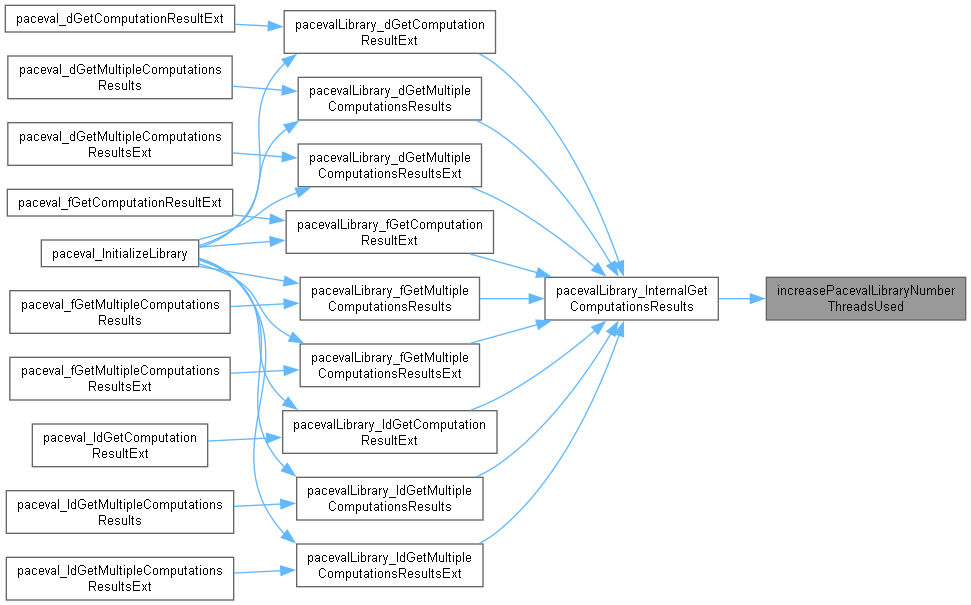
| void increasePacevalLibraryNumberThreadsUsed | ( | ) |
increases the counter for the number of threads used by 1

| bool paceval_cComputation_doComputation | ( | PACEVAL_HANDLE | handle_pacevalComputation_in, |
| const bool | singleCalculation_in, | ||
| const unsigned long | startSpecificAtNode_in, | ||
| const unsigned long | endSpecificAtNode_in, | ||
| const unsigned int | sizeOfLongDouble_in, | ||
| const paceval_eCalculationPrecisionTypes | useCalculationPrecision_in, | ||
| void * | result_out, | ||
| const unsigned long | stackNumber, | ||
| bool * | error_out, | ||
| void * | errorInformation_out, | ||
| void * | trustedMinResult_out, | ||
| void * | trustedMaxResult_out ) |
carries out a concrete calculation in the area of a start node and end node and returns whether an error occurred
| handle_pacevalComputation_in | the pointer to the paceval computation object managed in the paceval library |
| singleCalculation_in | specifies whether this is the main computation that traverses the entire list of nodes (true) or is a minor computation that traverses only part of the list of nodes (false) |
| startSpecificAtNode_in | specifies the node at which the calculation is started |
| endSpecificAtNode_in | specifies the node at which the calculation ends |
| sizeOfLongDouble_in | specifies the size in bytes of long double in the calling system determined via sizeof(long double) |
| useCalculationPrecision_in | specifies the precision with which the calculation is performed |
| result_out | the buffer for the result of the calculation with the specified precision |
| stackNumber | the number of the stack, e.g. for the values of the variables of the specific calculation |
| error_out | the buffer whether an error occurred during the calculation (true) or not (false) |
| errorInformation_out | the specific error information |
| trustedMinResult_out | this buffer retrieves the minimum/lower interval limit of the calculation (annotation: in case of an error the value is not specified) |
| trustedMaxResult_out | this buffer retrieves the maximum/upper limit of the calculation (annotation: in case of an error the value is not specified) |
carries out a concrete calculation in the area of a start node and end node and returns whether an error occurred
| handle_pacevalComputation_in | the pointer to the paceval computation object managed in the paceval library |
| singleCalculation_in | specifies whether this is the main computation that traverses the entire list of nodes (true) or is a minor computation that traverses only part of the list of nodes (false) |
| startSpecificAtNode_in | specifies the node at which the calculation is started |
| endSpecificAtNode_in | specifies the node at which the calculation ends |
| sizeOfLongDouble_in | specifies the size in bytes of long double in the calling system determined via sizeof(long double) |
| useCalculationPrecision_in | specifies the precision with which the calculation is performed |
| result_out | the buffer for the result of the calculation with the specified precision |
| stackNumber_in | the number of the stack, e.g. for the values of the variables of the specific calculation |
| error_out | the buffer whether an error occurred during the calculation (true) or not (false) |
| errorInformation_out | the specific error information |
| trustedMinResult_out | this buffer retrieves the minimum/lower interval limit of the calculation (annotation: in case of an error the value is not specified) |
| trustedMaxResult_out | this buffer retrieves the maximum/upper limit of the calculation (annotation: in case of an error the value is not specified) |

| unsigned long paceval_getCurrentTime | ( | ) |
forward declaration - gets the current time in milliseconds since the system started (see paceval_cCleanupHandler.h)
gets the current time in milliseconds since the system started

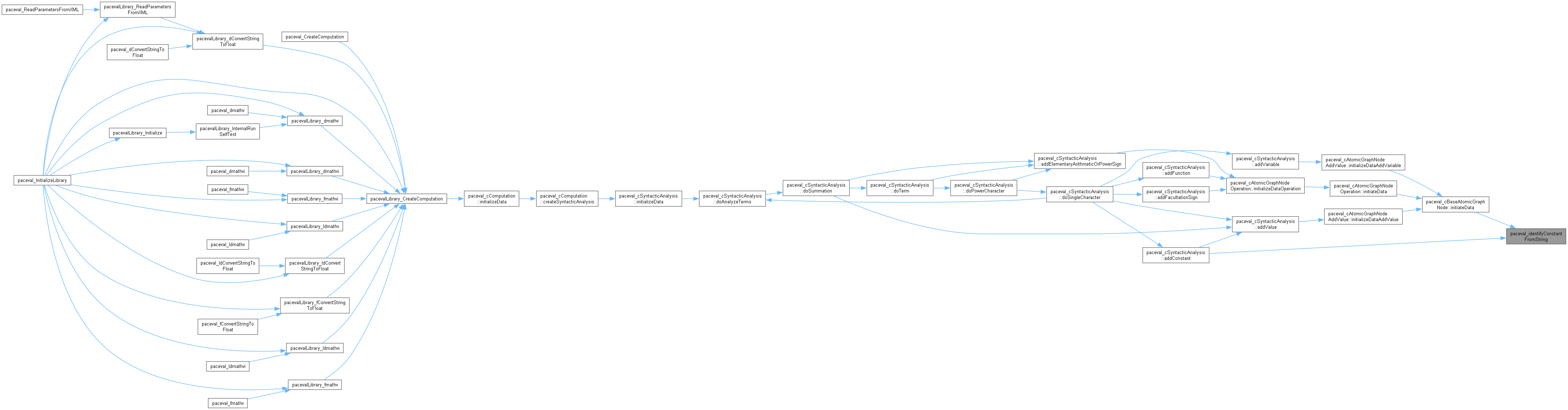
| bool paceval_identifyConstantFromString | ( | const char * | valueOperator_in, |
| bool * | constantValueIsTrusted_out, | ||
| long double * | constantValueAsLongDouble_out, | ||
| double * | constantValueAsDouble_out, | ||
| float * | constantValueAsFloat_out ) |
identifies a passed mathematical constant (e.g. "pi") or paceval-internal constant (e.g. "paceval_VersionNumber") and returns its value in any precision if the respective buffer is not NULL and whether this is known (true) or not (false) (annotation: we treat the paceval-internal values as temporary constants because they are set when the paceval_cComputation object is created to improve the performance, so they do not change while the paceval_cComputation object is in use)
this is the list of implemented constants that can be used in functions:
| valueOperator_in | specifies the operator as a string to be identified |
| constantValueIsTrusted_out | the buffer that retrieves whether the constant is trusted (true, e.g. "paceval_VersionNumber") or not (false, e.g. "pi") |
| constantValueAsLongDouble_out | the buffer that retrieves the value of the constant with the precision long double |
| constantValueAsDouble_out | the buffer that retrieves the value of the constant with the precision double |
| constantValueAsFloat_out | the buffer that retrieves the value of the constant with the precision float |


| bool paceval_lockGlobalVariables | ( | ) |
locks global variables for access during multithreading and returns true on success

| bool paceval_precheckMultipleComputations | ( | PACEVAL_HANDLE | handle_pacevalComputations_in[], |
| unsigned long | numberOfpacevalComputations_in ) |
performs a precheck of the paceval_cComputation objects for multiple operations, e.g. a handle may only occur once
| handle_pacevalComputations_in | array of the paceval_cComputation objects |
| numberOfpacevalComputations_in | specifies the number of the paceval_cComputation objects |

| void paceval_unlockGlobalVariables | ( | ) |
unlocks global variables for accesses

| PACEVAL_HANDLE pacevalLibrary_CreateComputation | ( | const char * | functionString_in, |
| unsigned long | numberOfVariables_in, | ||
| const char * | variables_in, | ||
| bool | useInterval_in, | ||
| paceval_callbackStatusType * | paceval_callbackStatus_in ) |
Foreign function interface (FFI - shared libraries) version of paceval_CreateComputation() (Windows DLLs and static libraries): creates a paceval_cComputation object for a mathematical function and its variables - the return value is the HANDLE of the created paceval_cComputation object (pacevalLibrary_GetIsError() should be called to check whether an error has occurred)
| functionString_in | points to a null-terminated string to be used as the function to work with |
| numberOfVariables_in | specifies the number of variables to work with (e.g. if the variables are "xValue yValue zValue" or "x y z" numberOfVariables_in must be set to 3) |
| variables_in | points to a null-terminated string specifying the names of the working variables (generally the variables must be separated by a blank, e.g. the variables xValue, yValue, zValue must be set with "xValue yValue zValue" or the variables x, y, z must be set with "x y z") |
| useInterval_in | enables or disables the Trusted Interval Computation, TINC (paceval specific) putting bounds on rounding errors and measurement errors of the computation system to yield reliable results |
| paceval_callbackStatus_in | a user-defined callback function to give status information of the paceval_cComputation object, see paceval_main.h |

| int pacevalLibrary_CreateErrorInformationText | ( | PACEVAL_HANDLE | handle_pacevalComputation_in, |
| char * | lastError_strMessage_out, | ||
| char * | lastError_strDetails_out ) |
Foreign function interface (FFI - shared libraries) version of paceval_CreateErrorInformationText() (Windows DLLs and static libraries): a helper function to create error information in text from a paceval_cComputation and it can be used to provide more information to the user - the return value is maximum length of lastError_strMessage_out and lastError_strDetails_out
| handle_pacevalComputation_in | identifies the paceval_cComputation object |
| lastError_strMessage_out | buffer to get message describing the error (annotation: maximum size of the retrieved null-terminated string is 255 per "#define PACEVAL_MAXERR 255", see paceval_main.h) |
| lastError_strDetails_out | buffer to get details like error type as a number, the operator and the position in the function (annotation: maximum size of the retrieved null-terminated string is 255 per "#define PACEVAL_MAXERR 255", see paceval_main.h) |

| bool pacevalLibrary_CreateMultipleComputations | ( | PACEVAL_HANDLE | handle_pacevalComputations_out[], |
| const char * | functionStrings_in[], | ||
| unsigned long | numberOfpacevalComputations_in, | ||
| unsigned long | numberOfVariables_in, | ||
| const char * | variables_in, | ||
| bool | useInterval_in, | ||
| paceval_callbackStatusType * | paceval_callbackStatus_in ) |
Foreign function interface (FFI - shared libraries) version of paceval_CreateMultipleComputations() (Windows DLLs and static libraries): creates paceval_cComputation objects for multiple mathematical functions and one set of variables in a single step - if the function succeeds, the return value is TRUE and handle_pacevalComputations_out contains the paceval_cComputation objects (each of these objects can be used individually, e.g. with pacevalLibrary_dGetComputationResult(), pacevalLibrary_dGetMultipleComputationsResults(), pacevalLibrary_dmathv() or pacevalLibrary_dmathvi() and must be deleted with pacevalLibrary_DeleteComputation())
| functionStrings_in | points to an array of null-terminated strings to be used as the functions to work with for the created paceval_cComputation objects |
| numberOfpacevalComputations_in | specifies the number of paceval_cComputation objects to create (e.g. if the functions to work with are "sin(x)" and "cos(x)" numberOfpacevalComputations_in must be set to 2) |
| numberOfVariables_in | specifies the number of variables to work with (e.g. if the variables are "xValue yValue zValue" or "x y z" numberOfVariables_in must be set to 3) |
| variables_in | points to a null-terminated string specifying the names of the working variables (generally the variables must be separated by a blank, e.g. the variables xValue, yValue, zValue must be set with "xValue yValue zValue" or the variables x, y, z must be set with "x y z") |
| useInterval_in | enables or disables the Trusted Interval Computation, TINC (paceval specific) putting bounds on rounding errors and measurement errors of the computation system to yield reliable results |
| paceval_callbackStatus_in | a user-defined callback function to give status information of the paceval_cComputation objects, see paceval_main.h |
| unsigned long pacevalLibrary_CreateXMLFromParameters | ( | char * | paceval_strXML_out, |
| const char * | functionString_in, | ||
| unsigned long | numberOfVariables_in, | ||
| const char * | variables_in, | ||
| const char * | valuesString_in, | ||
| bool | useInterval_in ) |
Foreign function interface (FFI - shared libraries) version of paceval_CreateXMLFromParameters() (Windows DLLs and static libraries): a helper function to create XML data representing a paceval_cComputation object and you can use it to store data representing a computation to a file system or to transmit it via a network or channel - the return value is the size of the XML data (in case of an error the return value is 0)
| paceval_strXML_out | pointer to a buffer for the XML data (set paceval_strXML_out to NULL to receive the length of the version string) |
| functionString_in | points to a null-terminated string representing the function |
| numberOfVariables_in | specifies the number of variables |
| variables_in | points to a null-terminated string specifying the names of the variables in one string seperated by blanks |
| valuesString_in | specifies the values for the variables in one string seperated by semicolons (;) |
| useInterval_in | specifies whether Trusted Interval Computation is enabled or not |
| int pacevalLibrary_dConvertFloatToString | ( | char * | destinationString_in, |
| double | float_in ) |
Foreign function interface (FFI - shared libraries) version of paceval_dConvertFloatToString() (Windows DLLs and static libraries): converts a floating point number with precision double to a string - if the function succeeds, the return value is >0 and gives the precision of the conversion, otherwise the return value is <0
| destinationString_in | points to the buffer that will receive the string of the coverted floating point number (annotation: in case of an error the buffer is not specified) |
| float_in | the floating point number with precision double to convert |

| double pacevalLibrary_dConvertStringToFloat | ( | const char * | sourceString_in, |
| int * | errorType_out, | ||
| long * | errPosition_out, | ||
| bool | useInterval_in, | ||
| double * | trustedMinResult_out, | ||
| double * | trustedMaxResult_out ) |
Foreign function interface (FFI - shared libraries) version of paceval_dConvertStringToFloat() (Windows DLLs and static libraries): converts a string to a floating point number with precision double (in case a caluclation is given in the string the result is converted) - if the function succeeds, the return value is the result of the conversion (annotation: in case of an error the return value is not specified)
| sourceString_in | the string to convert |
| errorType_out | points to the buffer that will receive the paceval_cComputation object error, see also paceval_eErrorTypes or pacevalLibrary_GetErrorInformation() |
| errPosition_out | position in the string where the error occurred |
| useInterval_in | enables or disables the Trusted Interval Computation, TINC (paceval specific) for the conversion |
| trustedMinResult_out | if Trusted Interval Computation was enabled this retrieves the minimum/lower interval limit of the conversion (annotation: in case of an error the value is not specified) |
| trustedMaxResult_out | if Trusted Interval Computation was enabled this retrieves the maximum/upper interval limit of the conversion (annotation: in case of an error the value is not specified) |
| bool pacevalLibrary_DeleteComputation | ( | PACEVAL_HANDLE | handle_pacevalComputation_in | ) |
Foreign function interface (FFI - shared libraries) version of paceval_DeleteComputation() (Windows DLLs and static libraries): deletes a paceval_cComputation object - if the function succeeds, the return value is TRUE (if the given HANDLE is not valid the return value is FALSE)
| handle_pacevalComputation_in | identifies the paceval_cComputation object to delete |

| double pacevalLibrary_dGetComputationResult | ( | PACEVAL_HANDLE | handle_pacevalComputation_in, |
| double | values_in[], | ||
| double * | trustedMinResult_out, | ||
| double * | trustedMaxResult_out ) |
Foreign function interface (FFI - shared libraries) version of paceval_dGetComputationResult() (Windows DLLs and static libraries): performs a calculation with precision double on a paceval_cComputation object with the variables declared by pacevalLibrary_CreateComputation() and with a set of values for those variables - if the function succeeds, the return value is the result of the computation (pacevalLibrary_GetIsError() should be called to check whether an error has occurred and to get more information about the error, call pacevalLibrary_GetErrorInformation()) (annotation: in case of an error the return value is not specified)
| handle_pacevalComputation_in | identifies the paceval_cComputation object |
| values_in | array of double defining the values of the variables |
| trustedMinResult_out | this buffer retrieves the minimum/lower interval limit of the computation (annotation: In case of an error the value is not specified) |
| trustedMaxResult_out | this buffer retrieves the maximum/upper limit of the computation (annotation: In case of an error the value is not specified) |
| bool pacevalLibrary_dGetComputationResultExt | ( | PACEVAL_HANDLE | handle_pacevalComputation_in, |
| double | values_in[], | ||
| unsigned long | numberOfCalculations_in, | ||
| double * | results_out, | ||
| double * | trustedMinResults_out, | ||
| double * | trustedMaxResults_out, | ||
| int * | errorTypes_out ) |
Foreign function interface (FFI - shared libraries) version of paceval_dGetComputationResultExt() (Windows DLLs and static libraries): performs multiple calculations with precision double in parallel on a single paceval_cComputation with the variables declared by pacevalLibrary_CreateComputation() and with multiple sets of values for those variables - the return value indicates paceval_cComputation object errors and you should check the array errorTypes_out in this case
| values_in | array of double defining the multiple values of the variables |
| numberOfCalculations_in | specifies the number of different calculations you want to run and this number specifies the size of the array values_in, e.g. if the number of variables declared is 50 and the number of calculations is 1000 the size of the array values_in must be 50*1000 (the order of the array values_in must be variable values for the first calculation, then variable values for the second calculation and so on) |
| results_out | pointer to an array for the results of the computation with the multiple values of the variables (annotation: in case of an error the values are not specified) |
| trustedMinResults_out | pointer to an array for the minimum/lower interval limits (annotation: in case of an error the values are not specified) |
| trustedMaxResults_out | pointer to an array for the maximum/upper interval limits (annotation: in case of an error the values are not specified) |
| errorTypes_out | pointer to an array of the paceval_cComputation object errors, see also paceval_eErrorTypes or pacevalLibrary_GetErrorInformation() |
| bool pacevalLibrary_dGetMultipleComputationsResults | ( | PACEVAL_HANDLE | handle_pacevalComputations_in[], |
| unsigned long | numberOfpacevalComputations_in, | ||
| double | values_in[], | ||
| double * | results_out, | ||
| double * | trustedMinResults_out, | ||
| double * | trustedMaxResults_out, | ||
| int * | errorTypes_out ) |
Foreign function interface (FFI - shared libraries) version of paceval_dGetMultipleComputationsResults() (Windows DLLs and static libraries): performs multiple calculations with precision double in parallel on multiple paceval_cComputation objects using the variables declared by pacevalLibrary_CreateComputation() and with the same set of values for these variables - the return value indicates paceval_cComputation object errors and you should check the array errorTypes_out in this case
| handle_pacevalComputations_in | array of the paceval_cComputation objects |
| numberOfpacevalComputations_in | specifies the number of the paceval_cComputation objects |
| values_in | array of double defining the values of the variables |
| results_out | pointer to an array for the results of the multiple computations (annotation: in case of an error the values are not specified) |
| trustedMinResults_out | pointer to an array for the minimum/lower interval limits (annotation: in case of an error the values are not specified) |
| trustedMaxResults_out | pointer to an array for the maximum/upper interval limits (annotation: in case of an error the values are not specified) |
| errorTypes_out | pointer to an array of the paceval_cComputation object errors, see also paceval_eErrorTypes or pacevalLibrary_GetErrorInformation() |
| bool pacevalLibrary_dGetMultipleComputationsResultsExt | ( | PACEVAL_HANDLE | handle_pacevalComputations_in[], |
| unsigned long | numberOfpacevalComputations_in, | ||
| double | values_in[], | ||
| unsigned long | numberOfCalculations_in, | ||
| double * | results_out, | ||
| double * | trustedMinResults_out, | ||
| double * | trustedMaxResults_out, | ||
| int * | errorTypes_out ) |
Foreign function interface (FFI - shared libraries) version of paceval_dGetMultipleComputationsResultsExt() (Windows DLLs and static libraries): performs multiple calculations with precision double in parallel on multiple paceval_cComputation objects using the variables declared by pacevalLibrary_CreateComputation() and with multiple sets of values for those variables - the return value indicates paceval_cComputation object errors and you should check the array errorTypes_out in this case
| handle_pacevalComputations_in | array of the paceval_cComputation objects |
| numberOfpacevalComputations_in | specifies the number of the paceval_cComputation objects |
| values_in | array of double defining the values of the variables |
| numberOfCalculations_in | specifies the number of different calculations you want to run and this number specifies the size of the array values_in, e.g. if the number of variables declared is 50 and the number of calculations is 1000 the size of the array values_in must be 50*1000 (the order of the array values_in must be variable values for the first calculation, then variable values for the second calculation and so on) |
| results_out | pointer to an array for the results of the multiple computations (annotation: in case of an error the values are not specified) |
| trustedMinResults_out | pointer to an array for the minimum/lower interval limits (annotation: in case of an error the values are not specified) |
| trustedMaxResults_out | pointer to an array for the maximum/upper interval limits (annotation: in case of an error the values are not specified) |
| errorTypes_out | pointer to an array of the paceval_cComputation object errors, see also paceval_eErrorTypes or pacevalLibrary_GetErrorInformation() |
| double pacevalLibrary_dmathv | ( | PACEVAL_HANDLE * | handle_pacevalComputation_out_in, |
| int * | errorType_out, | ||
| const char * | functionString_in, | ||
| unsigned long | numberOfVariables_in, | ||
| const char * | variables_in, | ||
| double | values_in[] ) |
Foreign function interface (FFI - shared libraries) version of paceval_dmathv() (Windows DLLs and static libraries): a convenience function to get results of computations in a single step with precision double - if the function succeeds, the return value is the result of the computation (pacevalLibrary_GetIsError() should be called to check whether an error has occurred and to get more information about the error, call pacevalLibrary_GetErrorInformation()) (annotation: in case of an error the return value is not specified)
| handle_pacevalComputation_out_in | pointer to a paceval_cComputation object (if handle_pacevalComputation_out_in is not NULL this buffer will retrieve the created paceval_cComputation object and can be used again and this will improve the performance -> in this case the paceval_cComputation object will not be deleted and you must call pacevalLibrary_DeleteComputation()) |
| errorType_out | points to the buffer that will receive the paceval_cComputation object error, see also paceval_eErrorTypes or pacevalLibrary_GetErrorInformation() |
| functionString_in | points to a null-terminated string to be used as the function to work with |
| numberOfVariables_in | specifies the number of variables to work with (e.g. if the variables are "xValue yValue zValue" or "x y z" numberOfVariables_in must be set to 3) |
| variables_in | points to a null-terminated string specifying the names of the working variables (generally the variables must be separated by a blank, e.g. the variables xValue, yValue, zValue must be set with "xValue yValue zValue" or the variables x, y, z must be set with "x y z") |
| values_in | array of double defining the values of the variables |
| double pacevalLibrary_dmathvi | ( | PACEVAL_HANDLE * | handle_pacevalComputation_out_in, |
| int * | errorType_out, | ||
| double * | trustedMinResult_out, | ||
| double * | trustedMaxResult_out, | ||
| const char * | functionString_in, | ||
| unsigned long | numberOfVariables_in, | ||
| const char * | variables_in, | ||
| double | values_in[] ) |
Foreign function interface (FFI - shared libraries) version of paceval_dmathvi() (Windows DLLs and static libraries): a convenience function to get results of computations in a single step with precision double and with Trusted Interval Computation, TINC (paceval specific) - if the function succeeds, the return value is the result of the computation (pacevalLibrary_GetIsError() should be called to check whether an error has occurred and to get more information about the error, call pacevalLibrary_GetErrorInformation()) (annotation: in case of an error the return value is not specified)
| handle_pacevalComputation_out_in | pointer to a paceval_cComputation object (if handle_pacevalComputation_out_in is not NULL this buffer will retrieve the created paceval_cComputation object and can be used again and this will improve the performance -> in this case the paceval_cComputation object will not be deleted and you must call pacevalLibrary_DeleteComputation()) |
| errorType_out | points to the buffer that will receive the paceval_cComputation object error, see also paceval_eErrorTypes or pacevalLibrary_GetErrorInformation() |
| trustedMinResult_out | this buffer retrieves the minimum/lower interval limit of the computation (annotation: In case of an error the value is not specified) |
| trustedMaxResult_out | this buffer retrieves the maximum/upper limit of the computation (annotation: In case of an error the value is not specified) |
| functionString_in | points to a null-terminated string to be used as the function to work with |
| numberOfVariables_in | specifies the number of variables to work with (e.g. if the variables are "xValue yValue zValue" or "x y z" numberOfVariables_in must be set to 3) |
| variables_in | points to a null-terminated string specifying the names of the working variables (generally the variables must be separated by a blank, e.g. the variables xValue, yValue, zValue must be set with "xValue yValue zValue" or the variables x, y, z must be set with "x y z") |
| values_in | array of double defining the values of the variables |
| bool pacevalLibrary_ExistComputation | ( | PACEVAL_HANDLE | handle_pacevalComputation_in | ) |
Foreign function interface (FFI - shared libraries) version of paceval_ExistComputation() (Windows DLLs and static libraries): determines whether a particular paceval_cComputation object has been created - if the object exists, the return value is TRUE. If the specified HANDLE is invalid or the object does not exist, the return value is FALSE
| handle_pacevalComputation_in | identifies the paceval_cComputation object to be questioned |
| int pacevalLibrary_fConvertFloatToString | ( | char * | destinationString_in, |
| float | float_in ) |
Foreign function interface (FFI - shared libraries) version of paceval_fConvertFloatToString() (Windows DLLs and static libraries): converts a floating point number with precision float to a string - if the function succeeds, the return value is >0 and gives the precision of the conversion, otherwise the return value is <0
| destinationString_in | points to the buffer that will receive the string of the coverted floating point number (annotation: in case of an error the buffer is not specified) |
| float_in | the floating point number with precision float to convert |
| float pacevalLibrary_fConvertStringToFloat | ( | const char * | sourceString_in, |
| int * | errorType_out, | ||
| long * | errPosition_out, | ||
| bool | useInterval_in, | ||
| float * | trustedMinResult_out, | ||
| float * | trustedMaxResult_out ) |
Foreign function interface (FFI - shared libraries) version of paceval_fConvertStringToFloat() (Windows DLLs and static libraries): converts a string to a floating point number with precision float (in case a caluclation is given in the string the result is converted) - if the function succeeds, the return value is the result of the conversion (annotation: in case of an error the return value is not specified)
| sourceString_in | the string to convert |
| errorType_out | points to the buffer that will receive the paceval_cComputation object error, see also paceval_eErrorTypes or pacevalLibrary_GetErrorInformation() |
| errPosition_out | position in the string where the error occurred |
| useInterval_in | enables or disables the Trusted Interval Computation, TINC (paceval specific) for the conversion |
| trustedMinResult_out | if Trusted Interval Computation was enabled this retrieves the minimum/lower interval limit of the conversion (annotation: in case of an error the value is not specified) |
| trustedMaxResult_out | if Trusted Interval Computation was enabled this retrieves the maximum/upper interval limit of the conversion (annotation: in case of an error the value is not specified) |
| float pacevalLibrary_fGetComputationResult | ( | PACEVAL_HANDLE | handle_pacevalComputation_in, |
| float | values_in[], | ||
| float * | trustedMinResult_out, | ||
| float * | trustedMaxResult_out ) |
Foreign function interface (FFI - shared libraries) version of paceval_fGetComputationResult() (Windows DLLs and static libraries): performs a calculation with precision float on a paceval_cComputation object with the variables declared by pacevalLibrary_CreateComputation() and with a set of values for those variables - if the function succeeds, the return value is the result of the computation (pacevalLibrary_GetIsError() should be called to check whether an error has occurred and to get more information about the error, call pacevalLibrary_GetErrorInformation()) (annotation: in case of an error the return value is not specified)
| handle_pacevalComputation_in | identifies the paceval_cComputation object |
| values_in | array of float defining the values of the variables |
| trustedMinResult_out | this buffer retrieves the minimum/lower interval limit of the computation (annotation: In case of an error the value is not specified) |
| trustedMaxResult_out | this buffer retrieves the maximum/upper limit of the computation (annotation: In case of an error the value is not specified) |
| bool pacevalLibrary_fGetComputationResultExt | ( | PACEVAL_HANDLE | handle_pacevalComputation_in, |
| float | values_in[], | ||
| unsigned long | numberOfCalculations_in, | ||
| float * | results_out, | ||
| float * | trustedMinResults_out, | ||
| float * | trustedMaxResults_out, | ||
| int * | errorTypes_out ) |
Foreign function interface (FFI - shared libraries) version of paceval_fGetComputationResultExt() (Windows DLLs and static libraries): performs multiple calculations with precision float in parallel on a single paceval_cComputation with the variables declared by pacevalLibrary_CreateComputation() and with multiple sets of values for those variables - the return value indicates paceval_cComputation object errors and you should check the array errorTypes_out in this case
| values_in | array of float defining the multiple values of the variables |
| numberOfCalculations_in | specifies the number of different calculations you want to run and this number specifies the size of the array values_in, e.g. if the number of variables declared is 50 and the number of calculations is 1000 the size of the array values_in must be 50*1000 (the order of the array values_in must be variable values for the first calculation, then variable values for the second calculation and so on) |
| results_out | pointer to an array for the results of the computation with the multiple values of the variables (annotation: in case of an error the values are not specified) |
| trustedMinResults_out | pointer to an array for the minimum/lower interval limits (annotation: in case of an error the values are not specified) |
| trustedMaxResults_out | pointer to an array for the maximum/upper interval limits (annotation: in case of an error the values are not specified) |
| errorTypes_out | pointer to an array of the paceval_cComputation object errors, see also paceval_eErrorTypes or pacevalLibrary_GetErrorInformation() |
| bool pacevalLibrary_fGetMultipleComputationsResults | ( | PACEVAL_HANDLE | handle_pacevalComputations_in[], |
| unsigned long | numberOfpacevalComputations_in, | ||
| float | values_in[], | ||
| float * | results_out, | ||
| float * | trustedMinResults_out, | ||
| float * | trustedMaxResults_out, | ||
| int * | errorTypes_out ) |
Foreign function interface (FFI - shared libraries) version of paceval_fGetMultipleComputationsResults() (Windows DLLs and static libraries): performs multiple calculations with precision float in parallel on multiple paceval_cComputation objects using the variables declared by pacevalLibrary_CreateComputation() and with the same set of values for these variables - the return value indicates paceval_cComputation object errors and you should check the array errorTypes_out in this case
| handle_pacevalComputations_in | array of the paceval_cComputation objects |
| numberOfpacevalComputations_in | specifies the number of the paceval_cComputation objects |
| values_in | array of float defining the values of the variables |
| results_out | pointer to an array for the results of the multiple computations (annotation: in case of an error the values are not specified) |
| trustedMinResults_out | pointer to an array for the minimum/lower interval limits (annotation: in case of an error the values are not specified) |
| trustedMaxResults_out | pointer to an array for the maximum/upper interval limits (annotation: in case of an error the values are not specified) |
| errorTypes_out | pointer to an array of the paceval_cComputation object errors, see also paceval_eErrorTypes or pacevalLibrary_GetErrorInformation() |
| bool pacevalLibrary_fGetMultipleComputationsResultsExt | ( | PACEVAL_HANDLE | handle_pacevalComputations_in[], |
| unsigned long | numberOfpacevalComputations_in, | ||
| float | values_in[], | ||
| unsigned long | numberOfCalculations_in, | ||
| float * | results_out, | ||
| float * | trustedMinResults_out, | ||
| float * | trustedMaxResults_out, | ||
| int * | errorTypes_out ) |
Foreign function interface (FFI - shared libraries) version of paceval_fGetMultipleComputationsResultsExt() (Windows DLLs and static libraries): performs multiple calculations with precision float in parallel on multiple paceval_cComputation objects using the variables declared by pacevalLibrary_CreateComputation() and with multiple sets of values for those variables - the return value indicates paceval_cComputation object errors and you should check the array errorTypes_out in this case
| handle_pacevalComputations_in | array of the paceval_cComputation objects |
| numberOfpacevalComputations_in | specifies the number of the paceval_cComputation objects |
| values_in | array of float defining the values of the variables |
| numberOfCalculations_in | specifies the number of different calculations you want to run and this number specifies the size of the array values_in, e.g. if the number of variables declared is 50 and the number of calculations is 1000 the size of the array values_in must be 50*1000 (the order of the array values_in must be variable values for the first calculation, then variable values for the second calculation and so on) |
| results_out | pointer to an array for the results of the multiple computations (annotation: in case of an error the values are not specified) |
| trustedMinResults_out | pointer to an array for the minimum/lower interval limits (annotation: in case of an error the values are not specified) |
| trustedMaxResults_out | pointer to an array for the maximum/upper interval limits (annotation: in case of an error the values are not specified) |
| errorTypes_out | pointer to an array of the paceval_cComputation object errors, see also paceval_eErrorTypes or pacevalLibrary_GetErrorInformation() |
| float pacevalLibrary_fmathv | ( | PACEVAL_HANDLE * | handle_pacevalComputation_out_in, |
| int * | errorType_out, | ||
| const char * | functionString_in, | ||
| unsigned long | numberOfVariables_in, | ||
| const char * | variables_in, | ||
| float | values_in[] ) |
Foreign function interface (FFI - shared libraries) version of paceval_fmathv() (Windows DLLs and static libraries): a convenience function to get results of computations in a single step with precision float - if the function succeeds, the return value is the result of the computation (pacevalLibrary_GetIsError() should be called to check whether an error has occurred and to get more information about the error, call pacevalLibrary_GetErrorInformation()) (annotation: in case of an error the return value is not specified)
| handle_pacevalComputation_out_in | pointer to a paceval_cComputation object (if handle_pacevalComputation_out_in is not NULL this buffer will retrieve the created paceval_cComputation object and can be used again and this will improve the performance -> in this case the paceval_cComputation object will not be deleted and you must call pacevalLibrary_DeleteComputation()) |
| errorType_out | points to the buffer that will receive the paceval_cComputation object error, see also paceval_eErrorTypes or pacevalLibrary_GetErrorInformation() |
| functionString_in | points to a null-terminated string to be used as the function to work with |
| numberOfVariables_in | specifies the number of variables to work with (e.g. if the variables are "xValue yValue zValue" or "x y z" numberOfVariables_in must be set to 3) |
| variables_in | points to a null-terminated string specifying the names of the working variables (generally the variables must be separated by a blank, e.g. the variables xValue, yValue, zValue must be set with "xValue yValue zValue" or the variables x, y, z must be set with "x y z") |
| values_in | array of float defining the values of the variables |

| float pacevalLibrary_fmathvi | ( | PACEVAL_HANDLE * | handle_pacevalComputation_out_in, |
| int * | errorType_out, | ||
| float * | trustedMinResult_out, | ||
| float * | trustedMaxResult_out, | ||
| const char * | functionString_in, | ||
| unsigned long | numberOfVariables_in, | ||
| const char * | variables_in, | ||
| float | values_in[] ) |
Foreign function interface (FFI - shared libraries) version of paceval_fmathvi() (Windows DLLs and static libraries): a convenience function to get results of computations in a single step with precision float and with Trusted Interval Computation, TINC (paceval specific) - if the function succeeds, the return value is the result of the computation (pacevalLibrary_GetIsError() should be called to check whether an error has occurred and to get more information about the error, call pacevalLibrary_GetErrorInformation()) (annotation: in case of an error the return value is not specified)
| handle_pacevalComputation_out_in | pointer to a paceval_cComputation object (if handle_pacevalComputation_out_in is not NULL this buffer will retrieve the created paceval_cComputation object and can be used again and this will improve the performance -> in this case the paceval_cComputation object will not be deleted and you must call pacevalLibrary_DeleteComputation()) |
| errorType_out | points to the buffer that will receive the paceval_cComputation object error, see also paceval_eErrorTypes or pacevalLibrary_GetErrorInformation() |
| trustedMinResult_out | this buffer retrieves the minimum/lower interval limit of the computation (annotation: In case of an error the value is not specified) |
| trustedMaxResult_out | this buffer retrieves the maximum/upper limit of the computation (annotation: In case of an error the value is not specified) |
| functionString_in | points to a null-terminated string to be used as the function to work with |
| numberOfVariables_in | specifies the number of variables to work with (e.g. if the variables are "xValue yValue zValue" or "x y z" numberOfVariables_in must be set to 3) |
| variables_in | points to a null-terminated string specifying the names of the working variables (generally the variables must be separated by a blank, e.g. the variables xValue, yValue, zValue must be set with "xValue yValue zValue" or the variables x, y, z must be set with "x y z") |
| values_in | array of float defining the values of the variables |
| bool pacevalLibrary_Free | ( | ) |
Foreign function interface (FFI - shared libraries) version of paceval_FreeLibrary() (Windows DLLs and static libraries): frees the paceval.-library - you must call pacevalLibrary_Free() at the end of your application - if the function succeeds, the return value is TRUE, otherwise it is FALSE
| unsigned long pacevalLibrary_GetComputationInformationXML | ( | PACEVAL_HANDLE | handle_pacevalComputation_in, |
| char * | paceval_strXML_out ) |
Foreign function interface (FFI - shared libraries) version of paceval_GetComputationInformationXML() (Windows DLLs and static libraries): a helper function for getting data from a paceval_cComputation object, such as the number of cores in the system, the number of threads used or the cache hits in the computations with that particular paceval_cComputation object - the return value is the size of the XML data (in case of an error the return value is 0)
| handle_pacevalComputation_in | identifies the paceval_cComputation object |
| paceval_strXML_out | pointer to a buffer for the XML data (set paceval_strXML_out to NULL to receive the length of the version string) |
| int pacevalLibrary_GetComputationVersionString | ( | PACEVAL_HANDLE | handle_pacevalComputation_in, |
| char * | paceval_strVersion_out ) |
Foreign function interface (FFI - shared libraries) version of paceval_GetComputationVersionString() (Windows DLLs and static libraries): returns the version string including the version number of the paceval_cComputation object - the return value is the length of the version string
| handle_pacevalComputation_in | identifies the paceval_cComputation object |
| paceval_strVersion_out | points to the buffer that will receive the string (set paceval_strVersion_in to NULL to receive the length of the version string) |
| int pacevalLibrary_GetErrorInformation | ( | PACEVAL_HANDLE | handle_pacevalComputation_in, |
| char * | lastError_strOperator_out, | ||
| long * | lastError_ePosition_out ) |
Foreign function interface (FFI - shared libraries) version of paceval_GetErrorInformation() (Windows DLLs and static libraries): returns the paceval_cComputation object error type value: possible errors are analysis and computation errors (errors during the analysis should be checked after creation of the object like pacevalLibrary_CreateComputation() while errors during the computation should be checked after a calculation, e.g. pacevalLibrary_GetComputationResult()) - the return value is the paceval_cComputation object error, see also paceval_eErrorTypes and you can retrieve further information for the error type via pacevalLibrary_CreateErrorInformationText(), e.g. to present this to the user:
| handle_pacevalComputation_in | identifies the paceval_cComputation object |
| lastError_strOperator_out | buffer to get the operator causing the error (annotation: maximum size of the retrieved null-terminated string is 255 per "#define PACEVAL_MAXERR 255", see paceval_main.h) |
| lastError_ePosition_out | position in the function where the error occurred |
| int pacevalLibrary_GetErrorTypeMessage | ( | int | errorType_in, |
| char * | errorType_strMessage_out ) |
Foreign function interface (FFI - shared libraries) version of paceval_GetErrorTypeMessage() (Windows DLLs and static libraries): a helper function to create an error message in text from an error type and It can be used to provide more information to the user - the return value is the length of lastError_strMessage_out
| errorType_in | specifies the the error type value |
| errorType_strMessage_out | buffer to get message describing the error (annotation: maximum size of the retrieved null-terminated string is 255 per "#define PACEVAL_MAXERR 255", see paceval_main.h) |
| bool pacevalLibrary_GetIsError | ( | PACEVAL_HANDLE | handle_pacevalComputation_in | ) |
Foreign function interface (FFI - shared libraries) version of paceval_GetIsError() (Windows DLLs and static libraries): determines whether an error has occurred and to get more information about the error, call pacevalLibrary_GetErrorInformation() - if an error has occurred, the return value is TRUE, otherwise it is FALSE
| handle_pacevalComputation_in | identifies the paceval_cComputation object |

| int pacevalLibrary_GetLoggingInformation | ( | char * | paceval_loggingInformation_out | ) |
returns the string of the logging information - the return value is the length of the logging string
| paceval_loggingInformation_out | points to the buffer that will receive the string (set paceval_strVersion_in to NULL to receive the length of the logging string) |

| bool pacevalLibrary_Initialize | ( | const char * | initString_in | ) |
Foreign function interface (FFI - shared libraries) version of paceval_InitializeLibrary() (Windows DLLs and static libraries): initializes the paceval-library - you must call pacevalLibrary_Initialize() before you use paceval-API function calls in your code - if the function succeeds, the return value is TRUE, otherwise it is FALSE
| initString_in | specifies a string that can be used for additional parameterization of the library, e.g. a string for licensing (annotation: if the string is not used, NULL can be passed) |
| bool pacevalLibrary_InternalGetComputationResult | ( | PACEVAL_HANDLE | handle_pacevalComputation_in, |
| unsigned long | numberOfThreadsToUse_in, | ||
| paceval_eCalculationPrecisionTypes | useCalculationPrecision_in, | ||
| void * | values_in, | ||
| void * | result_out, | ||
| unsigned int | sizeOfLongDouble_in, | ||
| long double * | trustedMinResult_out, | ||
| long double * | trustedMaxResult_out ) |
performs a calculation on a paceval_cComputation object with the variables declared by pacevalLibrary_CreateComputation() and with a set of values for those variables
| handle_pacevalComputation_in | identifies the paceval_cComputation object |
| numberOfThreadsToUse_in | specifies the number of threads to use for paceval_dGetMultipleComputationsResults() [paceval_ldGetMultipleComputationsResults(), paceval_fGetMultipleComputationsResults()] |
| useCalculationPrecision_in | specifies the precision with which the calculation should be performed |
| values_in | specifies the pointer to the array of variable values to use as floating point values for this calculation |
| result_out | the buffer for the result of the calculation in the precision defined with useCalculationPrecision_in (annotation: in case of an error the value is not specified) |
| sizeOfLongDouble_in | specifies the size in bytes of long double in the calling system determined via sizeof(long double) |
| trustedMinResult_out | if Trusted Interval Computation was enabled by pacevalLibrary_CreateComputation() this retrieves the minimum/lower interval limit of the computation (annotation: in case of an error the value is not specified) |
| trustedMaxResult_out | if Trusted Interval Computation was enabled by pacevalLibrary_CreateComputation() this retrieves the maximum/upper interval limit limit of the computation (annotation: in case of an error the value is not specified) |


| int pacevalLibrary_ldConvertFloatToString | ( | char * | destinationString_in, |
| long double | float_in ) |
Foreign function interface (FFI - shared libraries) version of paceval_ldConvertFloatToString() (Windows DLLs and static libraries): converts a floating point number with precision long double to a string - if the function succeeds, the return value is >0 and gives the precision of the conversion, otherwise the return value is <0
| destinationString_in | points to the buffer that will receive the string of the coverted floating point number (annotation: in case of an error the buffer is not specified) |
| float_in | the floating point number with precision long double to convert |
| long double pacevalLibrary_ldConvertStringToFloat | ( | const char * | sourceString_in, |
| int * | errorType_out, | ||
| long * | errPosition_out, | ||
| bool | useInterval_in, | ||
| long double * | trustedMinResult_out, | ||
| long double * | trustedMaxResult_out ) |
Foreign function interface (FFI - shared libraries) version of paceval_ldConvertStringToFloat() (Windows DLLs and static libraries): converts a string to a floating point number with precision long double (in case a caluclation is given in the string the result is converted) - if the function succeeds, the return value is the result of the conversion (annotation: in case of an error the return value is not specified)
| sourceString_in | the string to convert |
| errorType_out | points to the buffer that will receive the paceval_cComputation object error, see also paceval_eErrorTypes or pacevalLibrary_GetErrorInformation() |
| errPosition_out | position in the string where the error occurred |
| useInterval_in | enables or disables the Trusted Interval Computation, TINC (paceval specific) for the conversion |
| trustedMinResult_out | if Trusted Interval Computation was enabled this retrieves the minimum/lower interval limit of the conversion (annotation: in case of an error the value is not specified) |
| trustedMaxResult_out | if Trusted Interval Computation was enabled this retrieves the maximum/upper interval limit of the conversion (annotation: in case of an error the value is not specified) |
| long double pacevalLibrary_ldGetComputationResult | ( | PACEVAL_HANDLE | handle_pacevalComputation_in, |
| long double | values_in[], | ||
| long double * | trustedMinResult_out, | ||
| long double * | trustedMaxResult_out ) |
Foreign function interface (FFI - shared libraries) version of paceval_ldGetComputationResult() (Windows DLLs and static libraries): performs a calculation with precision long double on a paceval_cComputation object with the variables declared by pacevalLibrary_CreateComputation() and with a set of values for those variables - if the function succeeds, the return value is the result of the computation (pacevalLibrary_GetIsError() should be called to check whether an error has occurred and to get more information about the error, call pacevalLibrary_GetErrorInformation()) (annotation: in case of an error the return value is not specified)
| handle_pacevalComputation_in | identifies the paceval_cComputation object |
| values_in | array of long double defining the values of the variables |
| trustedMinResult_out | this buffer retrieves the minimum/lower interval limit of the computation (annotation: In case of an error the value is not specified) |
| trustedMaxResult_out | this buffer retrieves the maximum/upper limit of the computation (annotation: In case of an error the value is not specified) |
| bool pacevalLibrary_ldGetComputationResultExt | ( | PACEVAL_HANDLE | handle_pacevalComputation_in, |
| long double | values_in[], | ||
| unsigned long | numberOfCalculations_in, | ||
| long double * | results_out, | ||
| long double * | trustedMinResults_out, | ||
| long double * | trustedMaxResults_out, | ||
| int * | errorTypes_out ) |
Foreign function interface (FFI - shared libraries) version of paceval_ldGetComputationResultExt() (Windows DLLs and static libraries): performs multiple calculations with precision long double in parallel on a single paceval_cComputation with the variables declared by pacevalLibrary_CreateComputation() and with multiple sets of values for those variables - the return value indicates paceval_cComputation object errors and you should check the array errorTypes_out in this case
| values_in | array of long double defining the multiple values of the variables |
| numberOfCalculations_in | specifies the number of different calculations you want to run and this number specifies the size of the array values_in, e.g. if the number of variables declared is 50 and the number of calculations is 1000 the size of the array values_in must be 50*1000 (the order of the array values_in must be variable values for the first calculation, then variable values for the second calculation and so on) |
| results_out | pointer to an array for the results of the computation with the multiple values of the variables (annotation: in case of an error the values are not specified) |
| trustedMinResults_out | pointer to an array for the minimum/lower interval limits (annotation: in case of an error the values are not specified) |
| trustedMaxResults_out | pointer to an array for the maximum/upper interval limits (annotation: in case of an error the values are not specified) |
| errorTypes_out | pointer to an array of the paceval_cComputation object errors, see also paceval_eErrorTypes or pacevalLibrary_GetErrorInformation() |
| bool pacevalLibrary_ldGetMultipleComputationsResults | ( | PACEVAL_HANDLE | handle_pacevalComputations_in[], |
| unsigned long | numberOfpacevalComputations_in, | ||
| long double | values_in[], | ||
| long double * | results_out, | ||
| long double * | trustedMinResults_out, | ||
| long double * | trustedMaxResults_out, | ||
| int * | errorTypes_out ) |
Foreign function interface (FFI - shared libraries) version of paceval_ldGetMultipleComputationsResults() (Windows DLLs and static libraries): performs multiple calculations with precision long double in parallel on multiple paceval_cComputation objects using the variables declared by pacevalLibrary_CreateComputation() and with the same set of values for these variables - the return value indicates paceval_cComputation object errors and you should check the array errorTypes_out in this case
| handle_pacevalComputations_in | array of the paceval_cComputation objects |
| numberOfpacevalComputations_in | specifies the number of the paceval_cComputation objects |
| values_in | array of long double defining the values of the variables |
| results_out | pointer to an array for the results of the multiple computations (annotation: in case of an error the values are not specified) |
| trustedMinResults_out | pointer to an array for the minimum/lower interval limits (annotation: in case of an error the values are not specified) |
| trustedMaxResults_out | pointer to an array for the maximum/upper interval limits (annotation: in case of an error the values are not specified) |
| errorTypes_out | pointer to an array of the paceval_cComputation object errors, see also paceval_eErrorTypes or pacevalLibrary_GetErrorInformation() |
| bool pacevalLibrary_ldGetMultipleComputationsResultsExt | ( | PACEVAL_HANDLE | handle_pacevalComputations_in[], |
| unsigned long | numberOfpacevalComputations_in, | ||
| long double | values_in[], | ||
| unsigned long | numberOfCalculations_in, | ||
| long double * | results_out, | ||
| long double * | trustedMinResults_out, | ||
| long double * | trustedMaxResults_out, | ||
| int * | errorTypes_out ) |
Foreign function interface (FFI - shared libraries) version of paceval_ldGetMultipleComputationsResultsExt() (Windows DLLs and static libraries): performs multiple calculations with precision long double in parallel on multiple paceval_cComputation objects using the variables declared by pacevalLibrary_CreateComputation() and with multiple sets of values for those variables - the return value indicates paceval_cComputation object errors and you should check the array errorTypes_out in this case
| handle_pacevalComputations_in | array of the paceval_cComputation objects |
| numberOfpacevalComputations_in | specifies the number of the paceval_cComputation objects |
| values_in | array of long double defining the values of the variables |
| numberOfCalculations_in | specifies the number of different calculations you want to run and this number specifies the size of the array values_in, e.g. if the number of variables declared is 50 and the number of calculations is 1000 the size of the array values_in must be 50*1000 (the order of the array values_in must be variable values for the first calculation, then variable values for the second calculation and so on) |
| results_out | pointer to an array for the results of the multiple computations (annotation: in case of an error the values are not specified) |
| trustedMinResults_out | pointer to an array for the minimum/lower interval limits (annotation: in case of an error the values are not specified) |
| trustedMaxResults_out | pointer to an array for the maximum/upper interval limits (annotation: in case of an error the values are not specified) |
| errorTypes_out | pointer to an array of the paceval_cComputation object errors, see also paceval_eErrorTypes or pacevalLibrary_GetErrorInformation() |
| long double pacevalLibrary_ldmathv | ( | PACEVAL_HANDLE * | handle_pacevalComputation_out_in, |
| int * | errorType_out, | ||
| const char * | functionString_in, | ||
| unsigned long | numberOfVariables_in, | ||
| const char * | variables_in, | ||
| long double | values_in[] ) |
Foreign function interface (FFI - shared libraries) version of paceval_ldmathv() (Windows DLLs and static libraries): a convenience function to get results of computations in a single step with precision long double - if the function succeeds, the return value is the result of the computation (pacevalLibrary_GetIsError() should be called to check whether an error has occurred and to get more information about the error, call pacevalLibrary_GetErrorInformation()) (annotation: in case of an error the return value is not specified)
| handle_pacevalComputation_out_in | pointer to a paceval_cComputation object (if handle_pacevalComputation_out_in is not NULL this buffer will retrieve the created paceval_cComputation object and can be used again and this will improve the performance -> in this case the paceval_cComputation object will not be deleted and you must call pacevalLibrary_DeleteComputation()) |
| errorType_out | points to the buffer that will receive the paceval_cComputation object error, see also paceval_eErrorTypes or pacevalLibrary_GetErrorInformation() |
| functionString_in | points to a null-terminated string to be used as the function to work with |
| numberOfVariables_in | specifies the number of variables to work with (e.g. if the variables are "xValue yValue zValue" or "x y z" numberOfVariables_in must be set to 3) |
| variables_in | points to a null-terminated string specifying the names of the working variables (generally the variables must be separated by a blank, e.g. the variables xValue, yValue, zValue must be set with "xValue yValue zValue" or the variables x, y, z must be set with "x y z") |
| values_in | array of long double defining the values of the variables |
| long double pacevalLibrary_ldmathvi | ( | PACEVAL_HANDLE * | handle_pacevalComputation_out_in, |
| int * | errorType_out, | ||
| long double * | trustedMinResult_out, | ||
| long double * | trustedMaxResult_out, | ||
| const char * | functionString_in, | ||
| unsigned long | numberOfVariables_in, | ||
| const char * | variables_in, | ||
| long double | values_in[] ) |
Foreign function interface (FFI - shared libraries) version of paceval_ldmathvi() (Windows DLLs and static libraries): a convenience function to get results of computations in a single step with precision long double and with Trusted Interval Computation, TINC (paceval specific) - if the function succeeds, the return value is the result of the computation (pacevalLibrary_GetIsError() should be called to check whether an error has occurred and to get more information about the error, call pacevalLibrary_GetErrorInformation()) (annotation: in case of an error the return value is not specified)
| handle_pacevalComputation_out_in | pointer to a paceval_cComputation object (if handle_pacevalComputation_out_in is not NULL this buffer will retrieve the created paceval_cComputation object and can be used again and this will improve the performance -> in this case the paceval_cComputation object will not be deleted and you must call pacevalLibrary_DeleteComputation()) |
| errorType_out | points to the buffer that will receive the paceval_cComputation object error, see also paceval_eErrorTypes or pacevalLibrary_GetErrorInformation() |
| trustedMinResult_out | this buffer retrieves the minimum/lower interval limit of the computation (annotation: In case of an error the value is not specified) |
| trustedMaxResult_out | this buffer retrieves the maximum/upper limit of the computation (annotation: In case of an error the value is not specified) |
| functionString_in | points to a null-terminated string to be used as the function to work with |
| numberOfVariables_in | specifies the number of variables to work with (e.g. if the variables are "xValue yValue zValue" or "x y z" numberOfVariables_in must be set to 3) |
| variables_in | points to a null-terminated string specifying the names of the working variables (generally the variables must be separated by a blank, e.g. the variables xValue, yValue, zValue must be set with "xValue yValue zValue" or the variables x, y, z must be set with "x y z") |
| values_in | array of long double defining the values of the variables |
| int pacevalLibrary_ReadParametersFromXML | ( | const char * | paceval_strXML_in, |
| unsigned long * | functionStringLength_out, | ||
| unsigned long * | variablesStringLength_out, | ||
| unsigned long * | numberOfVariables_out, | ||
| unsigned long * | valuesStringLength_out, | ||
| char * | functionString_out, | ||
| char * | variables_out, | ||
| char * | valuesString_out, | ||
| bool * | useInterval_out ) |
Foreign function interface (FFI - shared libraries) version of paceval_ReadParametersFromXML() (Windows DLLs and static libraries): a helper function to read XML data representing a paceval_cComputation object and you can use it to read data representing a computation from a file system or to receive it via a network or channel - in case of an error the return value is <0
| paceval_strXML_in | pointer to the XML data |
| functionStringLength_out | the length of the function string |
| variablesStringLength_out | the length of the variable names in one string |
| numberOfVariables_out | the number of variables |
| valuesStringLength_out | the length of the values seperated by blanks in one string |
| functionString_out | points to the buffer for the function string (set functionString_out to NULL to receive the length at first with functionStringLength_out) |
| variables_out | points to the buffer for the variable names in one string (set variables_out to NULL to receive the length at first with variablesStringLength_out) |
| valuesString_out | points to the buffer for the values seperated by semicolons (;) in one string (set valuesString_out to NULL to receive the length at first with valuesStringLength_out) |
| useInterval_out | points to the buffer specifying whether Trusted Interval Computation is enabled or not |
| bool pacevalLibrary_SetCallbackUserFunction | ( | unsigned int | numberUserFunction_in, |
| const char * | singleFunctionString_in, | ||
| paceval_callbackUserFunctionType * | paceval_callbackUserFunction_in ) |
Foreign function interface (FFI - shared libraries) version of paceval_SetCallbackUserFunction() (Windows DLLs and static libraries): allows the definition of up to 1000 custom user functions. Depending on your requirements, you could a) add mathematical functions that enable new functions or b) add faster mathematical functions that are not as accurate as those used by paceval - if the function succeeds, the return value is TRUE, otherwise it is FALSE
| numberUserFunction_in | specifies the number of the user function to set the single function for, e.g. 1 |
| singleFunctionString_in | points to a null-terminated string specifying the user-defined single function, e.g. "my_function1" |
| paceval_callbackUserFunction_in | a user-defined callback function to handle the computation for the specific single function, see paceval_main.h |